Free ACT Practice Test Questions
Our practice tests cover the four multiple-choice ACT sections: English, math, reading, and science.
On the current (enhanced) ACT, English, math and reading are required. Science is optional and does not count toward your Composite score.
- ACT Math Practice Test
- ACT Science Practice Test
- ACT English Practice Tests
- ACT Reading Practice Test
What Are ACT Practice Exams?
ACT practice exams contain questions that mimic those on the real ACT. They measure the skills you learned in high school, so you know what to expect on test day.
Timed practice is one of the most useful ways to prepare. Your high school coursework still matters most, but practice shows you the format and your weak spots. Check also our Best ACT Prep Course here.
Learn more: ACT Math Overview, Content-Type, And Tips To Score High
Try a Free Practice Test
ACT English Practice Test ACT Math Practice Test ACT Science Practice Test ACT Reading Practice Test
ACT English Practice Test 1 ACT Math Practice Test 1 ACT Science Practice Test 1 ACT Reading Practice Test 1
While nothing beats focused study in high school to ace the ACT, all students can increase their chances of getting a better score by reviewing for the test and taking ACT practice tests and online courses.
How to Use the Practice Test

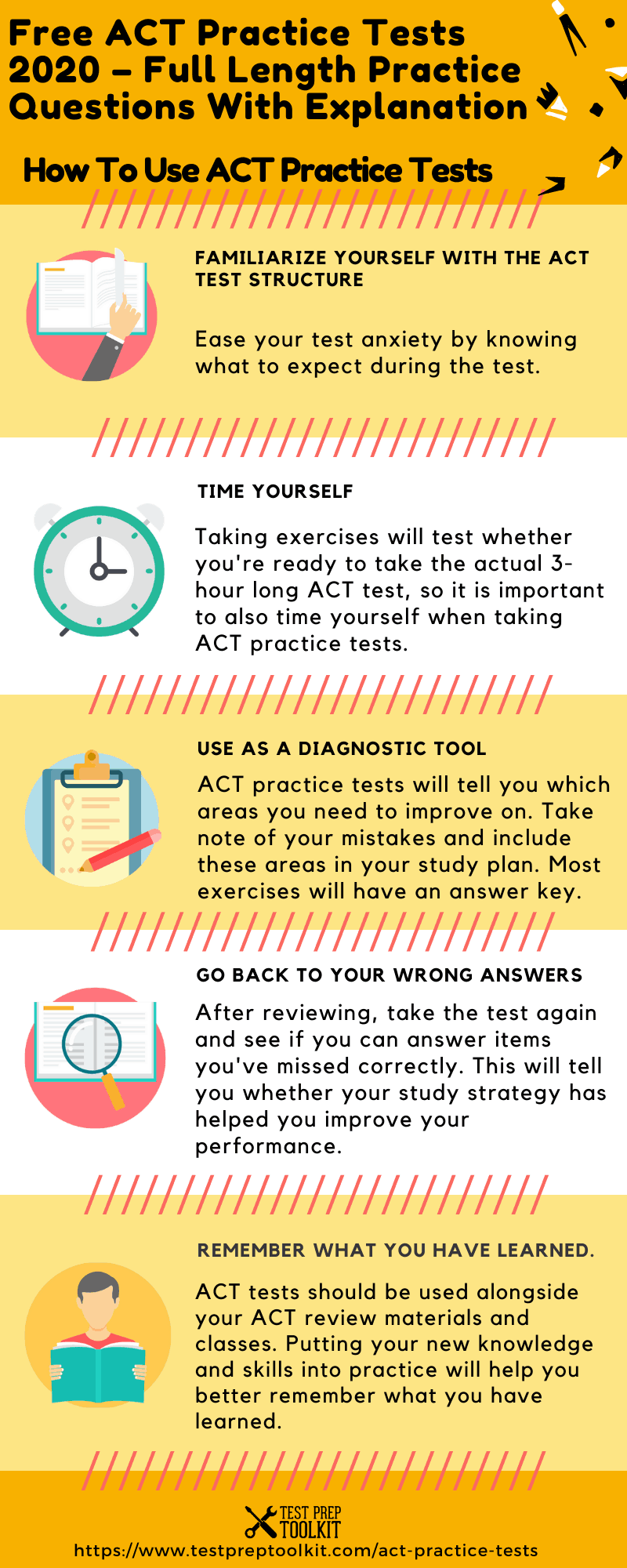
Familiarize yourself with the test structure. Ease your examination anxiety by knowing what to expect during the test.
Time yourself. The enhanced ACT takes 2 hours and 5 minutes for English, math and reading, or 2 hours and 45 minutes with science. Practice under the same section time limits.
Use as a diagnostic tool. Practice tests will tell you which sections you want to improve on. Note your mistakes and add those topics to your study plan. Use the answer key to check every question.
Go back to your wrong answers. After reviewing, take the examination again and see if you can answer items you’ve missed correctly. This will tell you if your studying strategy has helped you improve your performance.
Remember what you have learned. ACT prep tests should be used alongside your ACT review materials and classes. Putting what you learn into practice helps you remember it.
- Pick The Practice Test You Want To Take
- ACT English
- ACT Math
- ACT Reading
- ACT Science
- ACT Test Scoring
- ACT Test Dates
- Upcoming Dates:
- Importance of doing an ACT Practice Test
We have the ACT Reading Basics & Practices to Improve Scores
Pick The Practice Test You Want To Take
The official tests below use the older (pre-2025) ACT format: longer sections, five answer choices in math, and science counted in the Composite. They are still good practice, but time yourself to the current limits. The free 2025-2026 Preparing for the ACT booklet has a full-length practice test in the current format.
ACT 2017-2018 Official Practice Test ACT Official Practice Test 2015-16 2014-2015 ACT Official Practice Test Official ACT Practice Test 2011-12 ACT Practice Test 2008-09 ACT Practice Test Official 2005
The enhanced ACT has 131 questions across English, math and reading, which take 2 hours and 5 minutes. The optional science section adds 40 questions and 40 minutes, and the optional writing test adds one essay and 40 minutes.
Some questions in each section are unscored field-test items, and every multiple-choice question has four answer choices, according to ACT's official test structure page.
| Test | Number Of Questions | Time | Description |
| English | 50 (40 scored) | 35 min | Multiple-choice questions on grammar, usage and revising writing |
| Math | 45 (41 scored) | 50 min | Multiple-choice math questions |
| Reading | 36 (27 scored) | 40 min | Multiple-choice reading comprehension questions |
| Science | 40 (34 scored) | 40 min | Optional. Multiple-choice data interpretation questions |
| Writing | 1 essay | 40 min | Optional. One essay |
| TOTAL (English, math, reading) | 131 | 2 hours 5 min | |
| With science | 171 | 2 hours 45 min |
Check our ACT Test Dates for 2021-2022
ACT English
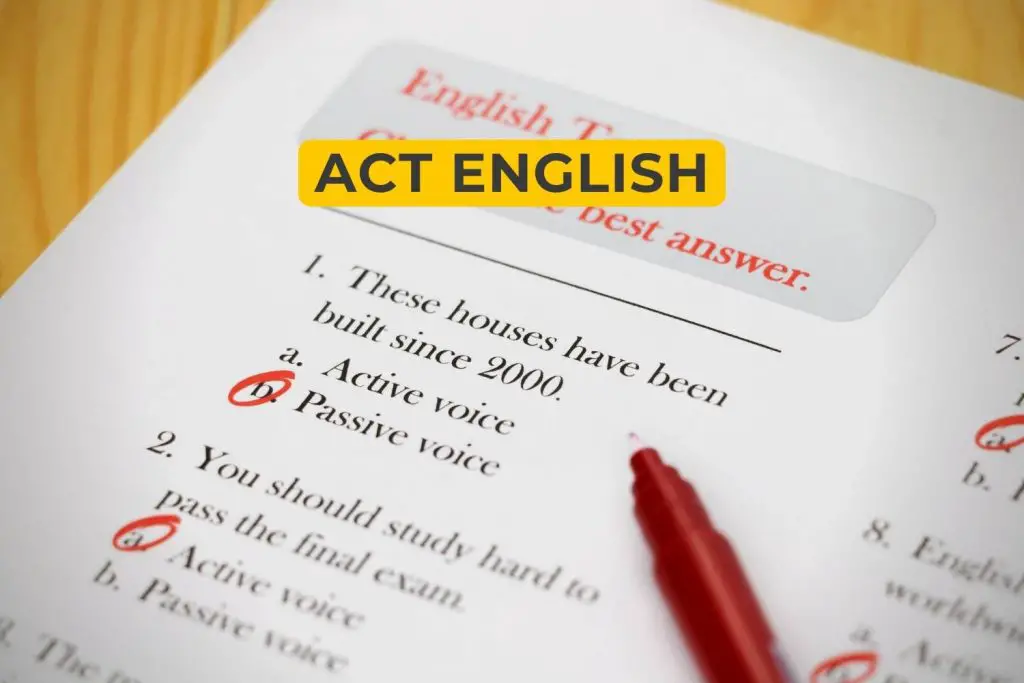
ACT English has 50 questions that you need to finish within 35 minutes. You revise and edit several essays or passages, with questions on punctuation, usage, sentence structure, organization and word choice.
Categories:
- Production of Writing (38%-43%)
- Knowledge of Language (18%-23%)
- Conventions of Standard English (38%-43%)
ACT English Practice Test ACT English Practice Test 1 ACT English Practice Test 2 ACT English Practice Test 3 ACT English Practice Test 4
Related Topic: ACT – Introduction, Registration, Dates & Score
ACT Math
The ACT Math has 45 multiple-choice questions that you need to answer within 50 minutes. It covers math typically learned in courses up to the beginning of grade 12. Each question has four answer choices, and basic formulas and computation are assumed knowledge. Test-takers are allowed to use a calculator, as long as it follows the ACT Calculator Policy.
Exam categories:
- Preparing for Higher Math (80%): number and quantity, algebra, functions, geometry, and statistics and probability
- Integrating Essential Skills (20%)
- Modeling (assessed throughout the test)
ACT Math Practice Test ACT Math Practice Test 1 ACT Math Practice Test 2 ACT Math Practice Test 3
Start reviewing with our helpful contents: ACT Scores
ACT Reading

The ACT Reading test has 36 multiple-choice questions that you need to complete within 40 minutes. Some parts have one long prose passage and others pair two shorter passages. Each passage has a heading that names the author and source and may give background information.
The test has no isolated vocabulary questions and no questions on rules of formal logic. Instead, you analyze the author’s point of view, compare details, follow sequences of events, find cause-and-effect relationships, and identify main ideas.
You can also visit our post here for some ACT Reading Tips.
Categories:
- Key Ideas and Details (44%-52%)
- Craft and Structure (26%-33%)
- Integration of Knowledge and Ideas (19%-26%)
Check our website here: ACT Registration And Requirements
ACT Science
The ACT Science test is optional. It has 40 multiple-choice questions that you need to answer in 40 minutes, and its score does not count toward your Composite. The test checks your ability to interpret, analyze, evaluate, and solve problems related to natural science. You will be presented with scientific information in forms of data representations, summaries of research, or conflicting views.
The content includes biology, chemistry, Earth and space science, and physics. Questions come in sets built around graphs, tables, figures or research summaries.
Categories:
- Interpretation of Data (38%-50%)
- Scientific Investigation (18%-32%)
- Evaluating Scientific Arguments and Models with Evidence (25%-35%)
ACT Science Practice Test ACT Science Practice Test 1 ACT Science Practice Test 2 ACT Science Practice Test 3 ACT Science Practice Test 4 ACT Science Practice Test 5
ACT Test Scoring
The ACT test is scored from 1 to 36. Each multiple-choice section is also scored from 1 to 36, and your Composite is the average of your English, math and reading scores, rounded to the nearest whole number. Science gets its own 1-36 score and is combined with math into a STEM score.
There is no penalty for wrong answers, so always guess if you are not sure. The optional essay is scored from 2 to 12 and does not affect your Composite. It is scored on four domains: ideas and analysis, development and support, organization, and language use and conventions.
ACT Test Dates

National ACT test dates are on Saturdays. Students who cannot test on Saturday for religious reasons can ask about non-Saturday testing when they register.
Many students take their first ACT in their junior year, then retest a few months later after working on weak areas.
Related Topic: ACT Test Dates for 2021-2022
Upcoming Dates:
These are the 2026-2027 U.S. national dates from ACT's test dates page:
- September 19, 2026
- October 17, 2026
- December 12, 2026
- February 27, 2027
- April 10, 2027
- June 12, 2027
- July 10, 2027
Importance of doing an ACT Practice Test

Practice tests help you learn the test structure, review content that might appear on the exam, and answer questions within the time limit. They also show which weak areas to focus on before test day.
It is highly recommended that students should have full-length ACT practice tests because:
- Full-length exercise tests provide a baseline score that can help students make a customized, efficient study plan.
Your practice scores show your strengths and weaknesses. You can then spend your study time on the sections that will raise your score most, instead of on topics you already know.
- Full-length practice tests deal with more than strategy and content.
Knowing the content is not the same as performing under time pressure. Full-length practice tests let you use your test-taking skills under the actual conditions of the ACT test. The practice test imitates the real conditions present in an official test so students can boost their test-taking skills.
- Practice tests measure progress.
Many students take one practice test before they start studying to get a baseline score. They take another in the middle of their prep and one or two more near the end to check their progress.
More ACT Article Reviews
Watch our Online GED Math Videos covering all topics you will face during the GED Math test